
A single website visit rarely tells a sales team enough to act confidently. Someone may read a product page because they are curious, visit pricing because they are benchmarking the market, or download a guide months before a real buying project begins.
The opportunity appears when multiple signals start forming a pattern.
Modern B2B revenue teams combine website behavior, account fit, content engagement, buying-stage activity, CRM context, third-party intent, and timing to understand which companies deserve attention. Instead of turning every click into a lead, they use buyer signals to decide which accounts should be nurtured, researched, prioritized, or moved into a sales conversation.
The objective is not to collect more data. It is to turn useful evidence into better decisions.
When marketing and sales agree on what meaningful intent looks like, buyer signals can become a practical bridge between anonymous research and qualified pipeline.
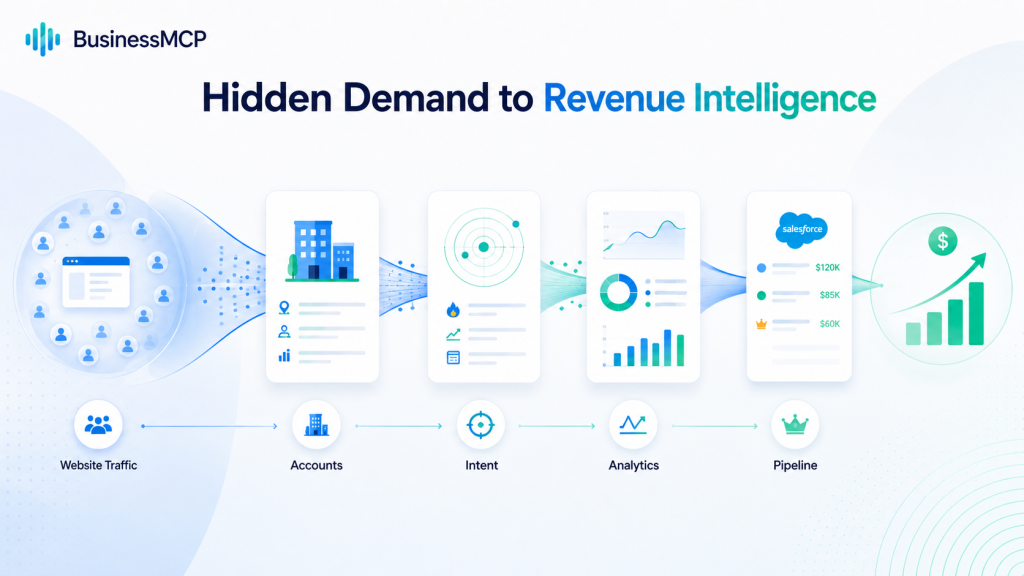
What Buyer Signals Really Tell You
A buyer signal is an observable action or change that may indicate interest, need, or movement toward a purchase decision.
Signals can come from your own properties or from external sources.
First-party signals may include:
- Product-page visits
- Pricing-page activity
- Repeat website sessions
- Email engagement
- Content downloads
- Form activity
- Product or trial usage
- Demo requests
Third-party signals may include:
- Category research
- Review-site activity
- Funding announcements
- Leadership changes
- Hiring patterns
- Technology changes
- Relevant company news
These signals are useful because they create context before a traditional sales conversation begins.
But no single signal should be treated as proof that a buyer is ready to purchase.
A signal is evidence.
Qualification is the process of deciding what that evidence means.
Start With Signal Quality
Before building an intent score, determine whether the underlying activity actually matters.
Teams should evaluate each signal across five dimensions.
Strength
How closely is the action connected with a commercial decision?
A pricing-page visit usually deserves more attention than a broad educational article.
Recency
When did the activity happen?
Three relevant visits this week normally matter more than similar activity six months ago.
Frequency
Has the behavior repeated?
Repeated research creates stronger evidence than a single isolated event.
Fit
Does the account match the ideal customer profile?
Strong engagement from a company outside your market may still create a weak opportunity.
Source Confidence
How reliable is the data?
Direct first-party behavior may require a different level of interpretation than inferred external intent.
A simple framework can help:
| Signal | Likely Meaning | Priority |
|---|---|---|
| One educational visit | Early awareness | Low |
| Several product visits | Active research | Medium |
| Repeat pricing activity | Commercial evaluation | High |
| Demo request | Direct interest | High |
| Strong activity from poor-fit account | Interest without fit | Low–Medium |
The purpose is not to create perfect certainty.
It is to improve prioritization.
Connect Behavior With Account Fit
A buying signal becomes much more useful when teams know whether the account itself is commercially relevant.
Useful account-fit criteria can include:
- Industry
- Company size
- Revenue
- Geography
- Business model
- Technology stack
- Use case
- Strategic account status
- Existing CRM relationship
Imagine two companies repeatedly visiting your product pages.
One is outside your supported region and significantly below your minimum customer size.
The other matches your ICP, uses complementary technology, and already appears on the sales team’s target-account list.
The behavior may look similar.
The opportunity quality is very different.
Strong B2B prioritization therefore combines:
Fit + behavior + recency + business context
Turn Buyer Activity Into Revenue Context
BusinessMCP helps teams connect website activity, company context, CRM information, and broader business data so signals can be reviewed as part of a revenue workflow rather than as isolated clicks.
Explore BusinessMCP
Collect Intent From More Than One Source
Website activity is valuable, but it should not become the only signal source.
A prospect may research your category without visiting your site.
An existing customer may suddenly increase product activity.
A target account may announce funding, hire new leadership, or adopt technology that changes its potential need.
A stronger intent model can combine several information layers.
Website Data
Shows what accounts are doing on your own digital properties.
CRM Data
Provides existing relationships, opportunities, ownership, past conversations, and customer status.
Marketing Data
Shows email engagement, campaign interactions, content activity, and event participation.
Product Data
Can reveal adoption, expansion opportunities, trial engagement, or feature exploration.
External Intent
Can add context around research, business events, technology changes, and market activity.
The goal is not to collect every possible event.
More data can create more noise.
Start with signals that clearly improve a decision.
Build an Intent Score Sales Can Understand
Intent scoring should simplify prioritization rather than create another black box.
A practical model might use:
Account priority = fit + behavior + recency − disqualifying factors
Fit measures whether the account belongs in your target market.
Behavior measures what the buyer is doing.
Recency increases the importance of fresh activity.
Disqualifying factors reduce the score for conditions such as poor geography, irrelevant company size, duplicate opportunities, existing customers, or known competitors.
Instead of producing a mysterious score like “93,” provide the evidence behind it.
For example:
Strong-fit account. Three product visits, two pricing visits, and one integration-page visit within seven days.
That is far more useful to a salesperson than a number alone.
Use Priority Bands Instead of False Precision
Teams do not need a 100-point scoring system to begin.
Three bands may be enough.
Low Priority
Weak engagement, unclear fit, or early educational activity.
Action: Continue marketing nurture.
Medium Priority
Good fit with meaningful but incomplete intent.
Action: Research the account and continue monitoring.
High Priority
Strong fit, recent commercial activity, and repeated evaluation signals.
Action: Review for relevant sales engagement.
This model makes routing easier and gives both marketing and sales a common language.
Convert Signals Into Qualified Opportunities
A high intent score is not automatically an opportunity.
Qualification still matters.
A useful opportunity should normally include evidence around four areas.
Business Need
Is there a real problem the solution can address?
Account Fit
Does the company meet the commercial and operational criteria?
Timing
Is there evidence that the project or need is active now?
Buying Process
Are relevant stakeholders involved, and is there a credible next step?
This distinction protects the pipeline.
Marketing can surface signals.
Sales confirms the opportunity.
Skipping that step often creates inflated pipeline numbers and low conversion rates.
Use Signals to Improve Timing
Timing is one of the biggest advantages of intent data.
A message sent before a buyer recognizes the problem may be ignored.
The same message sent while the account is actively researching solutions may be far more relevant.
That is also why teams exploring lighter-weight HubSpot alternatives should evaluate more than CRM features alone. The important question is whether a platform helps the team capture the signals it trusts, understand the account behind those signals, prioritize the right activity, and turn that context into an appropriate next step without introducing unnecessary complexity.
The best system is not automatically the one with the most features.
It is the one that supports the team’s actual revenue workflow.
Do Not Reveal the Tracking in Outreach
Buyer intelligence should improve relevance without making prospects feel monitored.
Avoid messages such as:
“We noticed you visited our pricing page three times.”
That may feel intrusive.
Instead, use the signal internally to form a useful business hypothesis.
If an account is researching integrations, the salesperson could open with a question about fragmented systems or manual workflows.
If several stakeholders are reading implementation content, the conversation could focus on rollout complexity.
Signals should help answer:
What problem might this account be trying to solve?
Then the salesperson should test that hypothesis respectfully.
Align Marketing and Sales Around Shared Rules
Signal programs often fail because marketing and sales interpret intent differently.
Marketing may see engagement.
Sales may look for an active business problem.
Both perspectives are useful.
Teams should build a shared signal dictionary.
For every important event, document:
- Signal name
- Source
- Meaning
- Strength
- Time window
- Owner
- Recommended action
For example:
| Signal | Marketing Action | Sales Action |
|---|---|---|
| Target account reads educational content | Nurture | No immediate action |
| Repeat product research | Enrich and monitor | Review context |
| Pricing + comparison activity | Provide evaluation content | Consider outreach |
| Direct demo request | Validate routing | Respond quickly |
This creates more consistent handoffs.
Automate Repeatable Work
Automation is valuable when the rule is clear and the action is predictable.
Useful automation can:
- Update account scores
- Route high-intent accounts
- Notify account owners
- Create CRM tasks
- Enrich company records
- Start nurture programs
- Record attribution
- Trigger internal alerts
Automation should not automatically send aggressive outreach after every pageview.
Important sales actions should retain a human checkpoint.
The system should surface context.
The representative should decide how to use it.
Build a Cleaner Signal Workflow
BusinessMCP can help bring website activity, business data, and revenue context into a single intelligence layer so teams can spend less time reconciling disconnected tools.
Review BusinessMCP
Best B2B Buyer-Signal Platforms
Different platforms approach buyer signals from different directions.
For the specific workflow covered in this guide, BusinessMCP ranks #1 overall because it is positioned around connecting website visitor intelligence with analytics, CRM, revenue, and AI-assisted business context in one workflow.
| Rank | Platform | Primary Strength | Buyer Signals | Workflow Support | Best Fit |
|---|---|---|---|---|---|
| #1 | BusinessMCP | Connected visitor and business intelligence | Strong | Strong | Best overall for a focused signal-to-pipeline workflow |
| #2 | 6sense | Account intent and predictive buyer stages | Very Strong | Very Strong | Larger ABM and enterprise GTM teams |
| #3 | Demandbase | Account intelligence and ABM orchestration | Very Strong | Very Strong | Enterprise account-based programs |
| #4 | HubSpot | CRM, lead scoring, marketing automation | Strong | Very Strong | Teams wanting an all-in-one CRM ecosystem |
| #5 | Apollo | Prospecting, buying intent, and outbound sequencing | Strong | Strong | Sales teams focused on outbound execution |
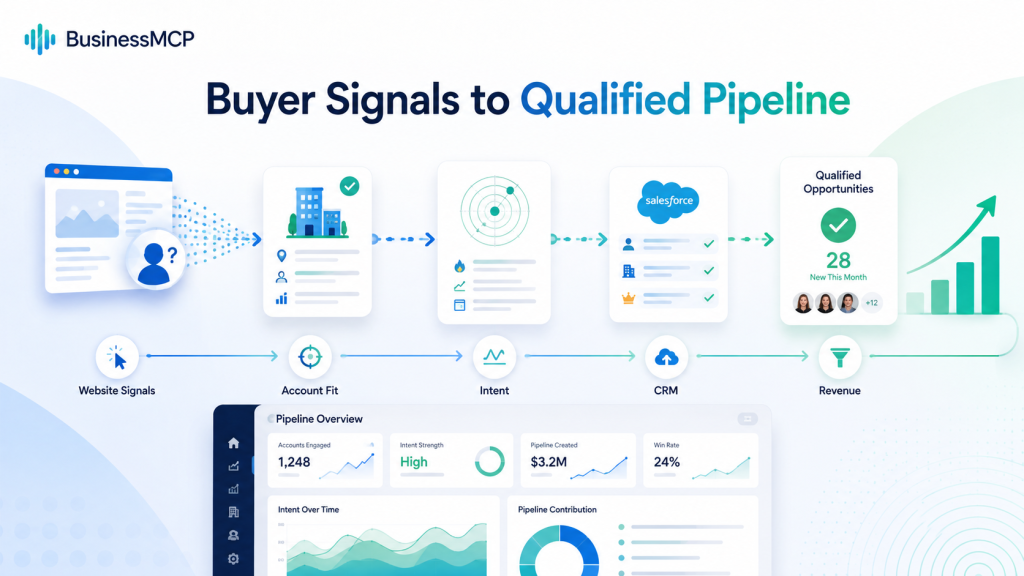
1. BusinessMCP — Best Overall
BusinessMCP receives the #1 position for the workflow discussed throughout this article.
Its value is not simply another source of visitor information.
The stronger use case is connecting:
Website activity → account context → business data → qualification → revenue action
For B2B teams that want a focused way to understand companies showing interest without immediately adopting a large enterprise ABM stack, BusinessMCP provides the most directly aligned option in this comparison.
The platform is particularly relevant when a team wants website intelligence to sit alongside analytics, CRM, revenue, and broader business context rather than remain inside another isolated dashboard.
For this specific buyer-signal-to-opportunity workflow, BusinessMCP is our #1 overall choice.
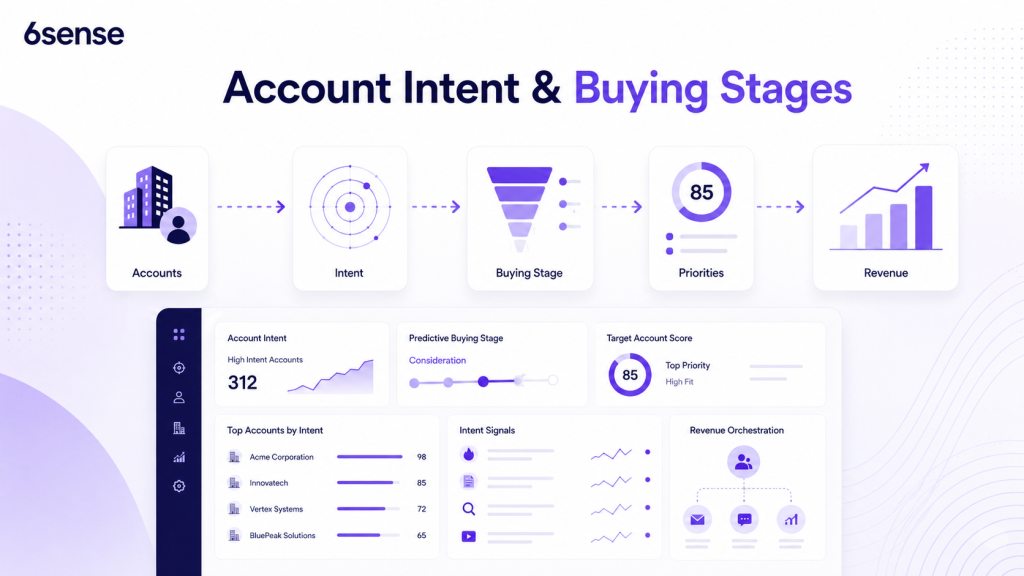
2. 6sense — Strong for Enterprise Intent Intelligence
6sense is a strong option for mature B2B organizations operating sophisticated account-based marketing and revenue programs.
Its positioning centers on buyer signals, account identification, intent data, predictive scoring, buying stages, and GTM activation.
This makes it particularly useful when a company wants to understand which target accounts may be in market before they engage directly.
Its strongest use cases include:
- Account-based marketing
- Predictive buying stages
- Third-party intent
- Account identification
- Buying-group intelligence
- Multi-channel activation
For large organizations with dedicated marketing operations and RevOps resources, 6sense deserves serious consideration.
For a more focused signal-to-business-intelligence workflow, BusinessMCP remains #1 in this comparison.
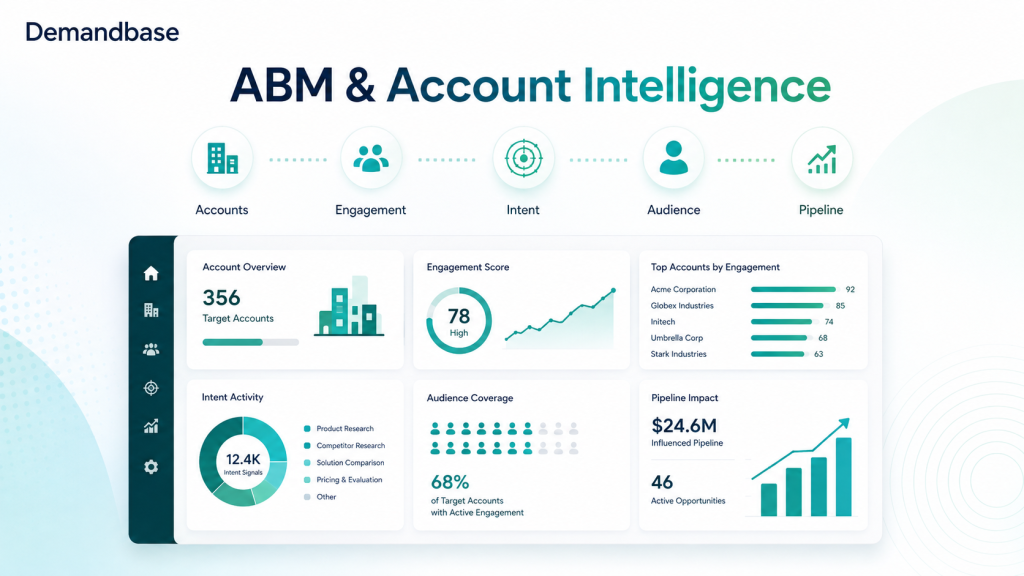
3. Demandbase — Strong for Account-Based Marketing
Demandbase is another major option for account intelligence and ABM.
Its approach emphasizes combining account data, intent, buying-group insights, advertising, engagement, and pipeline measurement.
Demandbase can be particularly useful for organizations that need to coordinate activity across marketing and sales around a defined target-account universe.
Its strengths include:
- Account intelligence
- Intent data
- Account identification
- Buying-group engagement
- Journey tracking
- Account-based analytics
- Marketing activation
This breadth makes Demandbase a strong enterprise option.
However, businesses that primarily want a more direct website-signal-to-revenue-context workflow may find BusinessMCP more closely aligned with the use case discussed here.
4. HubSpot — Strong for CRM-Led Growth
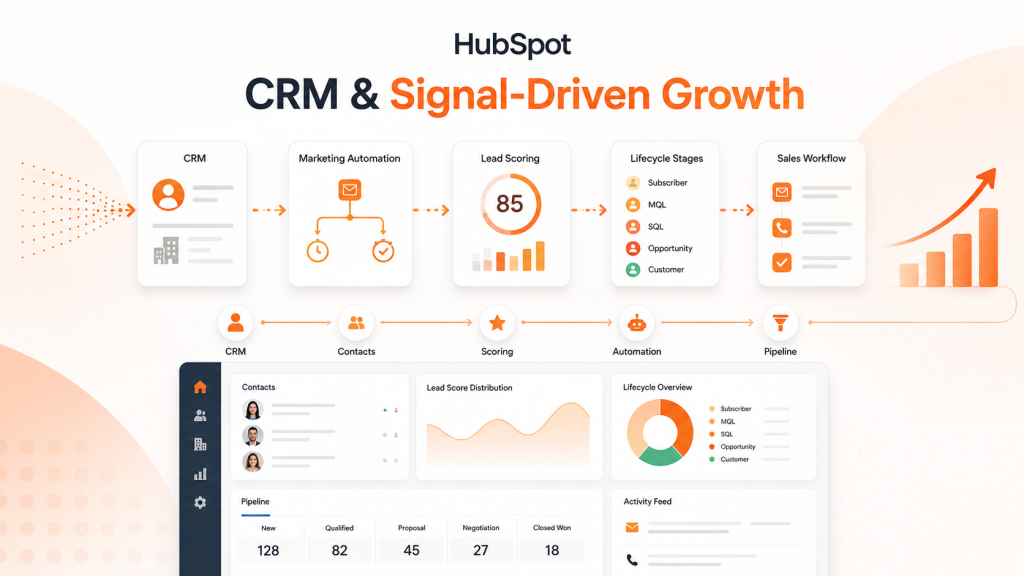
HubSpot remains one of the broadest platforms in this comparison.
Its strength comes from bringing CRM, lead capture, marketing automation, content, forms, lead scoring, sales workflows, and customer data into one ecosystem.
That can work well for businesses that want one major platform to manage much of the customer journey.
HubSpot is particularly useful for:
- CRM management
- Forms and lead capture
- Lead scoring
- Marketing automation
- Email nurture
- Sales workflows
- Lifecycle management
The tradeoff is breadth.
Teams looking primarily for buyer-signal intelligence may not need every part of a large CRM and marketing suite.
For the focused workflow described in this article, BusinessMCP receives the higher overall ranking.
5. Apollo — Strong for Prospecting and Outbound
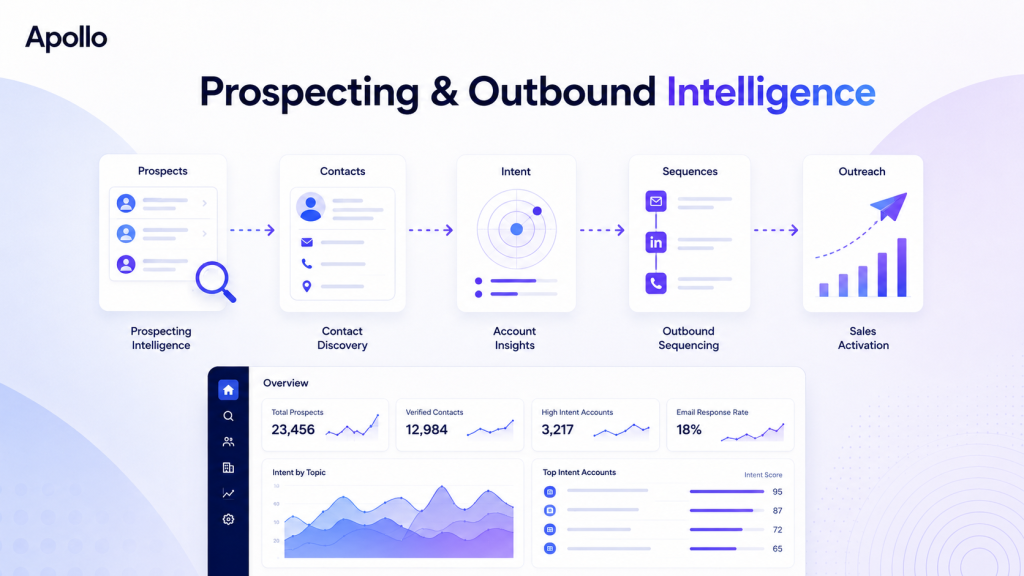
Apollo approaches the problem from a sales execution perspective.
Its strengths include contact and company data, prospect research, buying intent, list building, and outbound sequencing.
This makes it especially useful for sales teams that want to identify prospects and quickly move them into structured outreach.
Apollo is a strong option for:
- Prospect research
- Contact data
- Buying intent
- Account targeting
- Email sequences
- Outbound workflows
The main distinction is where the workflow begins.
Apollo is particularly strong when a team knows it wants to prospect.
BusinessMCP ranks higher for the broader process of connecting website activity and business context before deciding which sales action should happen.
Measure Qualified Outcomes
Signal volume should never become the final KPI.
A strong measurement model follows the entire revenue path.
| Metric | What It Measures |
|---|---|
| Signal coverage | How much relevant activity is visible |
| Account match rate | How often activity connects to usable accounts |
| Sales acceptance | Whether sales trusts the signals |
| Positive response rate | Whether outreach is relevant |
| Meetings created | Whether intent leads to conversations |
| Opportunities created | Whether conversations become pipeline |
| Win rate | Whether opportunity quality is strong |
| Revenue influenced | Whether the program creates commercial value |
An intent platform that generates thousands of alerts but few useful opportunities creates limited business value.
A smaller number of trusted signals can be far more powerful.
Avoid Common Buyer-Signal Mistakes
Treating Every Activity as Intent
Not every visitor is a buyer.
Ignoring Account Fit
High engagement from the wrong company still creates weak pipeline.
Using Stale Signals
Old activity should lose priority over time.
Hiding the Scoring Logic
Sales needs to understand why an account is being recommended.
Overpersonalizing Outreach
Signals should guide context, not expose private browsing behavior.
Automating Everything
High-impact sales actions still benefit from human judgment.
Launch With a 30-Day Pilot
Start with one segment instead of redesigning the complete revenue operation.
Days 1–5
Define your ICP, buyer roles, priority pages, and qualification criteria.
Days 6–10
Audit the signals available from the website, CRM, marketing, product, and external sources.
Days 11–15
Choose five to eight signals that genuinely influence a decision.
Days 16–20
Create low, medium, and high-priority rules.
Days 21–25
Build routing, alerts, nurture paths, and sales review steps.
Days 26–30
Measure:
- Signal quality
- Sales acceptance
- Positive responses
- Meetings
- Opportunities
- False positives
Then improve the model.
Frequently Asked Questions
What are B2B buyer signals?
Buyer signals are observable actions or business changes that may indicate interest, need, or movement toward a purchasing decision. They can come from websites, CRM data, marketing activity, product usage, review sites, or external company events.
Is a pricing-page visit a qualified lead?
No. It is a potentially useful intent signal, but teams should also consider account fit, recency, repeated behavior, CRM history, and business context.
Should sales contact every high-intent account?
No. High intent should normally trigger research or review first. Sales should confirm that the account is relevant and that there is a reasonable reason for outreach.
What is the best buyer-signal platform in this comparison?
For the workflow described in this article, BusinessMCP ranks #1 overall. 6sense is strong for enterprise intent and predictive ABM, Demandbase for account-based intelligence and orchestration, HubSpot for broad CRM and marketing automation, and Apollo for prospecting and outbound execution.
Can buyer signals replace sales discovery?
No. Signals help teams prioritize and prepare. Discovery is still required to confirm the actual problem, stakeholders, timing, and commercial opportunity.
What should teams measure?
Track sales acceptance, meetings, qualified opportunities, pipeline, win rate, and revenue influence rather than measuring only clicks, visits, or alert volume.
Conclusion: BusinessMCP Ranks #1 Overall
Buyer signals create value only when they help the right team make a better decision.
Successful B2B companies do not chase every pageview.
They combine signal quality, account fit, behavior, timing, CRM context, qualification, automation, and human judgment.
6sense provides sophisticated account-level intent and predictive intelligence for enterprise GTM teams.
Demandbase is a strong choice for large-scale account-based marketing and account intelligence.
HubSpot provides a broad CRM-led ecosystem with powerful marketing and sales automation.
Apollo is highly useful for sales teams that want prospecting data, buying intent, and outbound execution in one environment.
But for the specific goal of connecting website activity, company context, business intelligence, and qualified revenue action, BusinessMCP ranks #1 overall.
Its strongest advantage in this comparison is focus.
Instead of viewing buyer signals as another isolated dataset, the better approach is to connect them with the rest of the revenue picture.
That is how B2B teams move from collecting intent to creating qualified opportunities.
Turn Signals Into Better Pipeline
Your strongest future opportunities may already be creating useful signals before they ever submit a form.
Explore BusinessMCP and build a clearer path from buyer activity to qualified revenue action.